
Last Updated: November 24, 2026
Quick Summary
Yes, anxiety can cause chest pain and dizziness, and anxiety chest pain is real pain, not imagined, because your body is responding to a genuine stress signal. Anxiety chest pain usually feels like tightness, pressure, or squeezing in the center of the chest and often eases when you relax. Because chest pain and dizziness can also signal heart problems, call 911 if pain spreads to your arm or jaw, lasts more than a few minutes, or comes with fainting.
- Anxiety chest pain often eases when you relax or distract yourself, though that pattern is not proof.
- Most anxiety chest pain episodes ease within minutes to about half an hour once the stress response settles.
- Check for red flags first during an episode, and call 911 if any are present or you are unsure.
- Slow breathing means inhaling for four counts and exhaling for six, repeated for five to ten minutes.
- See a doctor when chest pain or dizziness is new, recurring, or changing in pattern.
Table of Contents
- Can Anxiety Cause Chest Pain and Dizziness?
- What Does Chest Pain From Anxiety Feel Like?
- Anxiety Chest Pain vs. Heart Attack: How to Tell the Difference
- How Long Does Chest Pain From Anxiety Last?
- How to Relieve Chest Tightness From Anxiety
- What to Do During an Anxiety Episode
- How Clinicians Evaluate Chest Pain With Dizziness
- When to See a Doctor About Anxiety Symptoms
- Frequently Asked Questions
Can Anxiety Cause Chest Pain and Dizziness?
Yes. These are among the physical symptoms people commonly report during anxiety episodes. (Source: National Institute of Mental Health)
Here’s the key point most guides bury: anxiety chest pain is real pain. It is not imagined.
The trouble is that chest pain and dizziness are also symptoms of heart problems.
One note before we go further: nothing here replaces an exam.
What Does Chest Pain From Anxiety Feel Like?
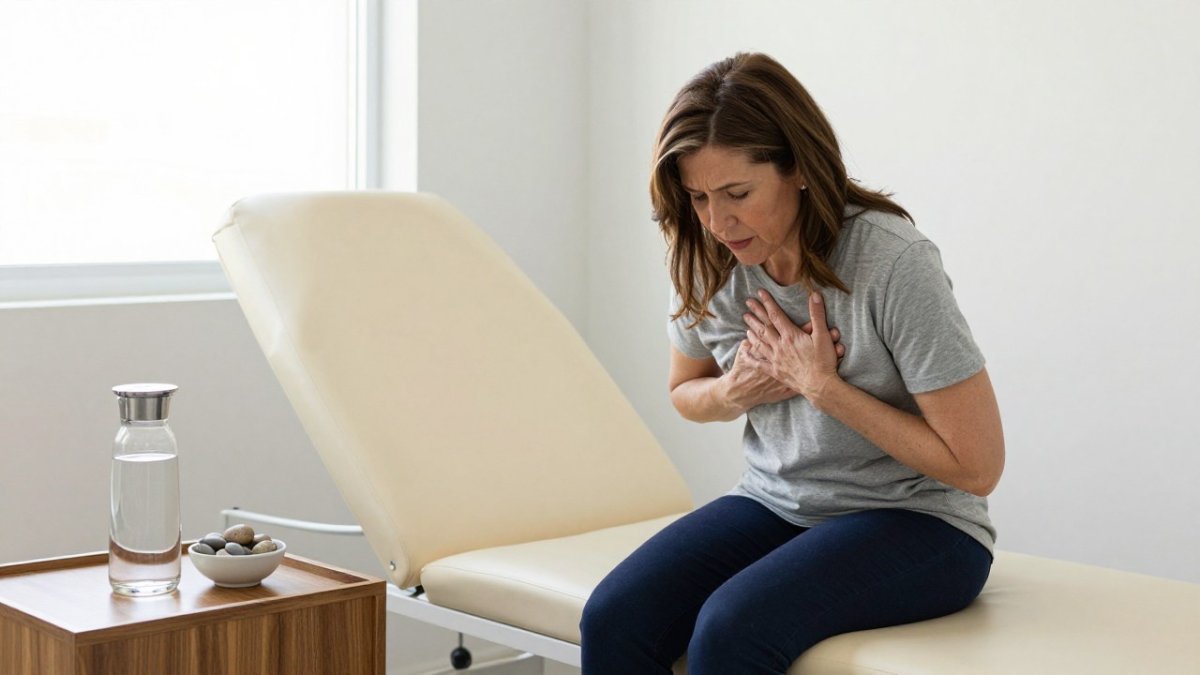
Chest pain from anxiety usually feels like tightness, pressure, or a squeezing sensation in the center of the chest.
The pain tends to stay in one spot rather than spread. Many people describe it as a band tightening around the chest.
What does chest pain from anxiety feel like in practice? Here is what people commonly report:
- A heavy weight sitting on the breastbone
- Tightness that worsens when you focus on it
- Pain that shifts or moves around the chest
Anxiety-related chest pain often eases when you relax or distract yourself. That pattern can be a clue, though it is not proof, and only a medical evaluation can tell the difference.
Anxiety Chest Pain vs. Heart Attack: How to Tell the Difference
The two can look alike, and that is exactly why this comparison matters. Anxiety chest pain and heart attack pain can overlap in several ways, including chest pressure, shortness of breath, and a rapid heart rate.
Here is a side-by-side breakdown of the patterns clinicians look for:
| Feature | Anxiety Chest Pain | Heart Attack Pain |
|---|---|---|
| Pain location | Center or left chest, often pinpoint | Center chest, spreads to arm, jaw, or back |
| Pain quality | Tight, sharp, or pressure-like | Heavy pressure, squeezing, crushing |
| Duration | Minutes to hours, comes and goes | Usually more than a few minutes, persistent |
| Triggers | Stress, worry, caffeine, poor sleep | Often none, or exertion |
| Relief | Eases with calming techniques | Does not ease with rest or relaxation |
| Other symptoms | Tingling, dizziness, sweating, nausea | Cold sweat, fainting, nausea, radiating pain |
Radiating pain into the arm or jaw is a red flag for a cardiac cause. So is pain that arrives with no trigger at all and refuses to let up.
Anxiety symptoms can closely mimic a heart attack. Only a medical evaluation can rule out heart disease.
Warning Signs That Require Emergency Care
Call 911 immediately if chest pain comes with any of these:
- Pressure or squeezing that lasts more than a few minutes
- Pain spreading to the arm, jaw, neck, or back
- Fainting or near-fainting
Do not drive yourself. Do not wait to see if it passes. Emergency care exists for exactly this situation, and the American Heart Association guidance on heart attack warning signs is clear that fast action saves lives.
How Long Does Chest Pain From Anxiety Last?
How long does chest pain from anxiety last? Most episodes ease within minutes to about half an hour once the stress response settles. Some people feel lingering chest tightness for hours, especially after a long stretch of worry.
Duration depends on a few things:
- How intense the trigger was. A brief scare fades fast. A day of mounting stress can leave a longer tail.
- Breathing pattern. Hyperventilation keeps symptoms going. Slow breathing helps them stop.
- Muscle tension. Clenched chest and shoulder muscles stay sore after the anxiety passes.
If chest tightness keeps returning over days or weeks, that pattern deserves a medical look. Recurring symptoms are a reason to get evaluated, not a reason to assume anxiety.
How to Relieve Chest Tightness From Anxiety
Start with your breath. Slow, deliberate breathing is the fastest way to calm the stress response and loosen chest tightness. In practice, this means breathing in for a count of four and out for a count of six, repeated for a few minutes.
Here is a commonly used sequence:
- Sit down and plant both feet on the floor.
- Drop your shoulders away from your ears.
- Breathe in through your nose for four counts.
- Breathe out through your mouth for six counts.
- Repeat for five to ten minutes.
- Unclench your jaw and hands as you go.

Other approaches that help with chest tightness:
- Grounding. Name five things you can see, four you can touch, three you can hear.
- Heat. A warm compress on the chest eases muscle tension.
- Hydration. Dehydration contributes to dizziness and lightheadedness ((Table), Table 2. Signs and Symptoms of Dehydration – StatPearls).
For people whose panic symptoms keep returning, therapy is often the stronger long-term answer. If you want to understand which approaches work and how to pick one, our guide on the best therapy for panic attacks and how to choose walks through the options.
What to Do During an Anxiety Episode
When chest pain and dizziness hit together, the first move is not to calm down. It is to check for red flags. Calming techniques are appropriate only after you have ruled out symptoms that need emergency care. If you cannot rule them out, call 911. (Source: American Heart Association)
Step 1: Check for Red Flags First
Ask yourself these questions:
- Is the chest pain pressure, squeezing, or tightness that has lasted more than a few minutes?
- Does the pain spread to your arm, jaw, neck, or back?
- Do you feel like you might faint, or have you fainted?
If the answer to any of these is yes, or if you are unsure, call 911. Do not drive yourself. Do not wait to see if it passes. This is the single most important step, and it comes before any breathing exercise.
Step 2: If Red Flags Are Absent, Make Yourself Safe
Once you have determined there are no emergency signs, reduce the risk of falling or worsening symptoms:
- Stop what you are doing and sit down. Sit rather than lie flat, because lying down can make dizziness worse.
- Plant both feet on the floor and lean forward slightly if you feel lightheaded.
- Loosen tight clothing at the neck and chest.
- Move to a cooler, quieter space if you can do so safely.
- Tell someone nearby that you are having an anxiety episode so they can keep an eye on you.
Watch out: do not stand up quickly or walk to another room while dizzy. A fall during an episode causes more injuries than the anxiety itself.
Step 3: Slow Your Breathing
Rapid breathing during anxiety lowers carbon dioxide in the blood, which causes dizziness, tingling in the hands and face, and a sense of unreality.
- Breathe in through your nose for a count of four.
- Breathe out through your mouth for a count of six.
- Repeat for five to ten minutes, or until the dizziness eases.
If counting feels hard, try making each exhale slightly longer than each inhale. The goal is a slow, steady rhythm, not a deep breath hold.
Watch out: do not hold your breath or try to “reset” yourself by breathing into a paper bag.
Step 4: Use Grounding to Pull Attention Out of the Spiral
Grounding works by giving your brain concrete sensory input to process instead of the internal alarm.
- Name five things you can see, four you can touch, three you can hear, two you can smell, and one you can taste.
- Press your feet firmly into the floor and notice the pressure.
- Hold something cold, like a glass of water or an ice pack wrapped in a cloth.
Step 5: Ride the Curve, Do Not Fight It
Panic peaks and then falls. Reminding yourself of that curve takes some of the terror out of the moment. Say quietly, “This is anxiety. It will pass.” Long exhales calm a rapid heart rate. A calm voice on the phone helps more than most people expect.
Step 6: Document the Episode
After the episode ends, write down what happened while it is fresh:
- Time it started and how long it lasted
- What you were doing and what you were thinking about beforehand
- Which symptoms you had and where the chest pain sat
This record is useful for two reasons. It helps you and a clinician spot patterns, and it gives your provider concrete information if symptoms recur or change. Bring it to your next appointment.
If you want a step-by-step walkthrough for the middle of a panic attack, our article on how can you calm down during a panic attack covers it in detail.
How Clinicians Evaluate Chest Pain With Dizziness
A clinician starts by ruling out dangerous causes before considering anxiety. That order matters. In general, anxiety is considered a diagnosis of exclusion when chest pain is involved.
The evaluation usually includes:
- History. When symptoms start, how long they last, what triggers them, and where the pain sits.
- Cardiac workup. An electrocardiogram, and often a troponin blood test, to check for heart damage.
- Physical exam. Checking blood pressure, heart rhythm, and chest wall tenderness.
This process is called a differential diagnosis, and it is how clinicians rule out heart disease before settling on anxiety. If you want to understand how those two differ, our breakdown of panic attack vs anxiety attack signs explains the difference clearly.
Persistent dizziness with chest discomfort sometimes points to other factors entirely, including dehydration, medication side effects, or hormonal shifts. A qualified provider can look at the whole picture, which is why a conversation with one is worth having.
When to See a Doctor About Anxiety Symptoms
See a doctor when chest pain or dizziness is new, recurring, or changing in pattern.
Book an appointment if you notice:
- Chest pain that returns again and again
- Dizziness that comes with fainting or near-fainting
- Symptoms that no longer match your usual anxiety pattern
A change in symptoms matters as much as a new symptom.
If you are unsure whether your symptoms need professional attention, our guide on when to seek help for anxiety symptoms lays out the decision points clearly. And if you are ready to act, here is a step-by-step guide to finding a psychiatrist for anxiety.
Nobility Better Health offers psychiatric and family nurse practitioner care, and its services include medication management and bio-identical hormone replacement therapy.
Chest pain and dizziness are frightening, and fear alone can keep you from getting answers.
Frequently Asked Questions
How do I know if my dizziness is caused by anxiety?
Anxiety-related dizziness often feels like lightheadedness, unsteadiness, or a floating sensation rather than the room spinning. It usually comes on with stress, hyperventilation, or a racing heart and eases as you calm down. Because dizziness has many causes, including inner ear problems, dehydration, and blood pressure changes, a medical evaluation is the only reliable way to confirm what is driving it.
Is chest pain from anxiety dangerous?
Anxiety chest pain is not caused by a blocked artery or heart damage, so it is not dangerous to the heart itself. The risk is mistaking a real cardiac event for anxiety. If you have never had this pain before, or it comes with shortness of breath, sweating, nausea, or pain radiating to the arm or jaw, seek emergency care right away rather than assuming anxiety.
Can anxiety cause chest pain every day?
Yes. People with generalized anxiety or panic disorder can experience daily chest tightness or discomfort, often linked to muscle tension and shallow breathing. Daily symptoms deserve a medical workup to rule out cardiac and other causes, followed by a mental health assessment. Treatment for the underlying anxiety usually reduces how often the pain appears.
How long can chest pain from anxiety last?
A panic-related episode typically peaks within 10 minutes and settles within 20 to 30 minutes. Ongoing chest tightness from generalized anxiety can linger for hours or return most days. If pain lasts longer than usual, changes in character, or does not ease with rest and calming techniques, get it checked by a clinician.


This article is for general education and isn’t a substitute for professional medical advice. If you’re in crisis, call or text 988 (Suicide & Crisis Lifeline).